UAV PCBs
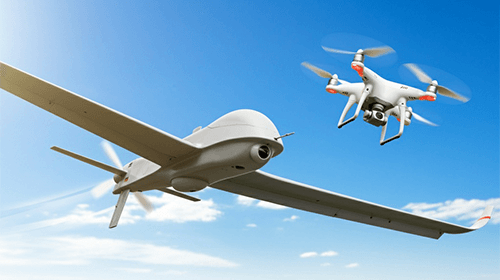
Unmanned Aerial Vehicles (UAVs) are primarily categorized by design and flight dynamics into fixed-wing, rotary-wing and hybrid types. All are driven by sophisticated electronic technologies in propulsion, autonomous navigation, flight control and include onboard high-speed data processing, long-range communications and specialized sensors. These various components must operate flawlessly within strict size, weight and power constraints and often in extreme environments.
UAV or Drone applications include Search & Rescue Missions, Critical Infrastructure Inspection, Military Maneuvers, Scientific Research, Agricultural Management, Autonomous Delivery Logistics and many others.
UAV Deep Integration of Components:
- Specialized Sensors: Optical, thermal, and multispectral cameras, LiDAR, and specific gas or chemical detectors.
- High-Speed Communication: Robust radio frequency (RF) systems and high-bandwidth optical communication technologies to ensure data transmission stability and speed.
- Embedded Systems: Onboard computers and microcontrollers for flight control, navigation and data acquisition.
- Power Management: Efficient power distribution and high-density battery systems (or alternative power sources like fuel cells) to maximize endurance and payload power.
PCB Capabilities Enabling UAV Electronics
Whether for commercial purposes or critical stealth missions, PCB Technologies focus our capabilities on enabling maximum efficiency, reliability and versatility for UAV operations. The electronics that drive UAV functionality demand expertise in miniaturization, ruggedization and high-performance signal integrity.
|
Technology |
Rationale for UAV |
Benefit |
|
High-Density Interconnect (HDI) PCBs |
Crucial for miniaturization, HDI technology features finer traces, micro-vias and higher layer counts; allowing more components to be packed into a reduced footprint. |
Significantly aids in weight reduction and compact design; essential for extended flight times and better maneuverability. |
|
Rigid-Flex PCBs |
Combines the durability of rigid boards with the flexibility of flexible circuits, allowing the PCB to bend and fold to fit into irregular, space-constrained areas within the Drone. |
Reduces the need for bulky connectors and cables, enhancing overall system reliability by minimizing potential failure points in high-vibration environments |
|
Advanced & |
UAVs need reliable communication and sensor performance, often at high frequencies (above 1 GHz). This requires special materials like polyimide or PTFE/Rogers laminates for stable dielectric constants (Dk) and low dissipation factors (Df), across wide temperature ranges. |
Effectively minimizes signal loss and ensures signal integrity even under harsh conditions. |
|
Thermal Management Solutions |
High-power electronics generate considerable heat. Countermeasures include thermally conductive substrates and special design features like thermal vias and copper pours. |
Prevents overheating and ensures component longevity along with reliable performance in demanding environments. |
|
Robust & Shielded Designs |
PCBs for UAVs must be adapted for harsh or rugged environments by use of stronger materials, strategic component placement, conformal coatings and dedicated ground planes/shielding. |
Ensures the ability to withstand extreme temperatures, shock and vibration, protects against moisture and corrosion and mitigates Electro-magnetic Interference (EMI). |
Advanced PCB Miniaturization Enables More Efficient Flight Missions
- Resource Optimization: Miniaturized systems integrate more mission-critical components packed into smaller spaces: sensors, wireless communication, control units, power generators etc. Boosts payload efficiency, reduces power losses, and better supports thermal management.
- Reliability & Flexibility: Integrating multiple microsystems into a silicon wafer and redundancy by design, increases reliability and flexibility. Smaller, more reliable systems reduce operating risks associated with complex flight missions, especially in harsh environments.
- Cost Reduction: Miniaturization reduces payload mass and volume, enabling more ambitious flight missions with increased agility, maneuverability and precision. Optimized performance results in lower costs across the entire system.
- iNPACK a PCB Technologies Subsidiary: Providing advanced semiconductor and electronics assembly, testing, IC package design, plus LGA, BGA and 2D & 3D customized solutions. MW microelectronics assemblies, System-in-Package (SiP), heterogeneous integration and much more.
PCB Technologies — Pushing the Boundaries of Drone Technology.
We Provide Custom Solutions for Drone Technology, Counter-UAV Systems & Prototyping.
A UAV or Drone PCB is not simply a substrate for electrical connections, but a mission-critical component, responsible for the overall reliability of the system. For that reason, we make sure that our PCBs enabling UAV technology fully support functional stability and flight efficiency, with no-fail operation.
As UAVs become increasingly independent, complex and application-specific, their underlying electronics must also evolve. PCB Technologies address this issue by positioning ourselves as vital partners in the evolutionary process; enabling optimal UAV and Drone performance, durability and innovation.
Defending Against Threats: Counter-UAV Systems
PCB Technologies empowers defense industries to master electronic warfare challenges. We specialize in thermal management, EMI compliance, and miniaturization for combat UAV countermeasures such as: laser systems, missile defense, and high-powered microwave solutions. Our unique heterogeneous engineering approach delivers peak performance in extreme environments.
Prototyping UAV PCB Designs for Success
- Ensures PCB design and functionality measures-up to the specific UAV or Drone application required (especially for experimental models).
- Prototyping is a highly practical method of validating design concepts, by identifying and correcting potential issues before they occur; like inadequate thermal management, power distribution errors or structural weaknesses.
- When you’re talking about industries like defense/military and aerospace, any compromise in product quality poses a critical risk, therefore prototyping isn’t just a convenience, it’s a necessity.
Let’s discuss your UAV project requirements. Our experts are available at your convenience.